📄 Digital book in PDF · read it on your phone or print it
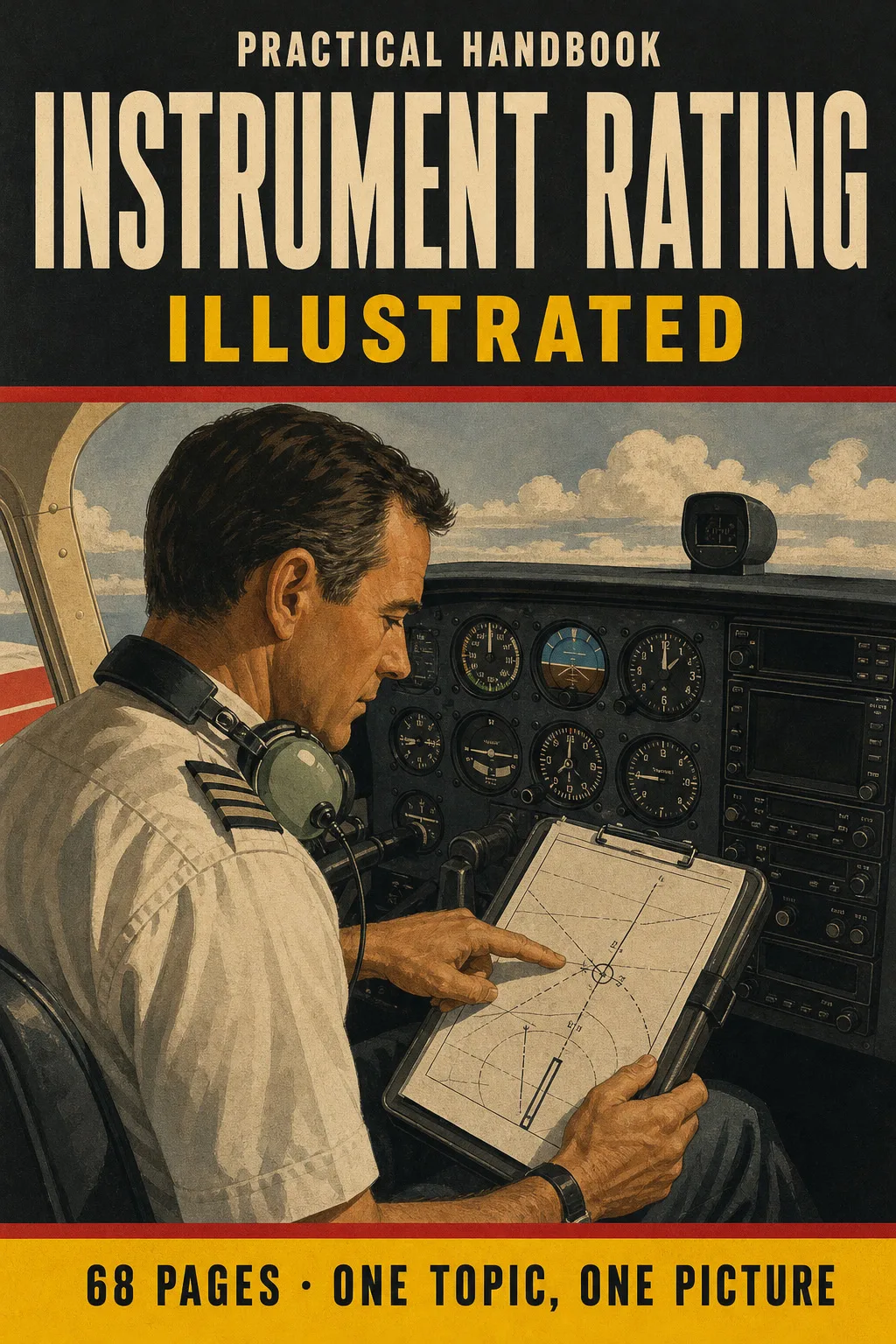
For the knowledge test, the checkride oral or your IPC: pitot-static failures, VOR and the CDI, hold entries, approach charts, the ILS, alternates, IFR fuel and lost comm. Every topic gets its own page: first the drawing, then what you need to remember. 68 illustrated pages.
🔒 Secure checkout · PDF by email · 30-day guarantee
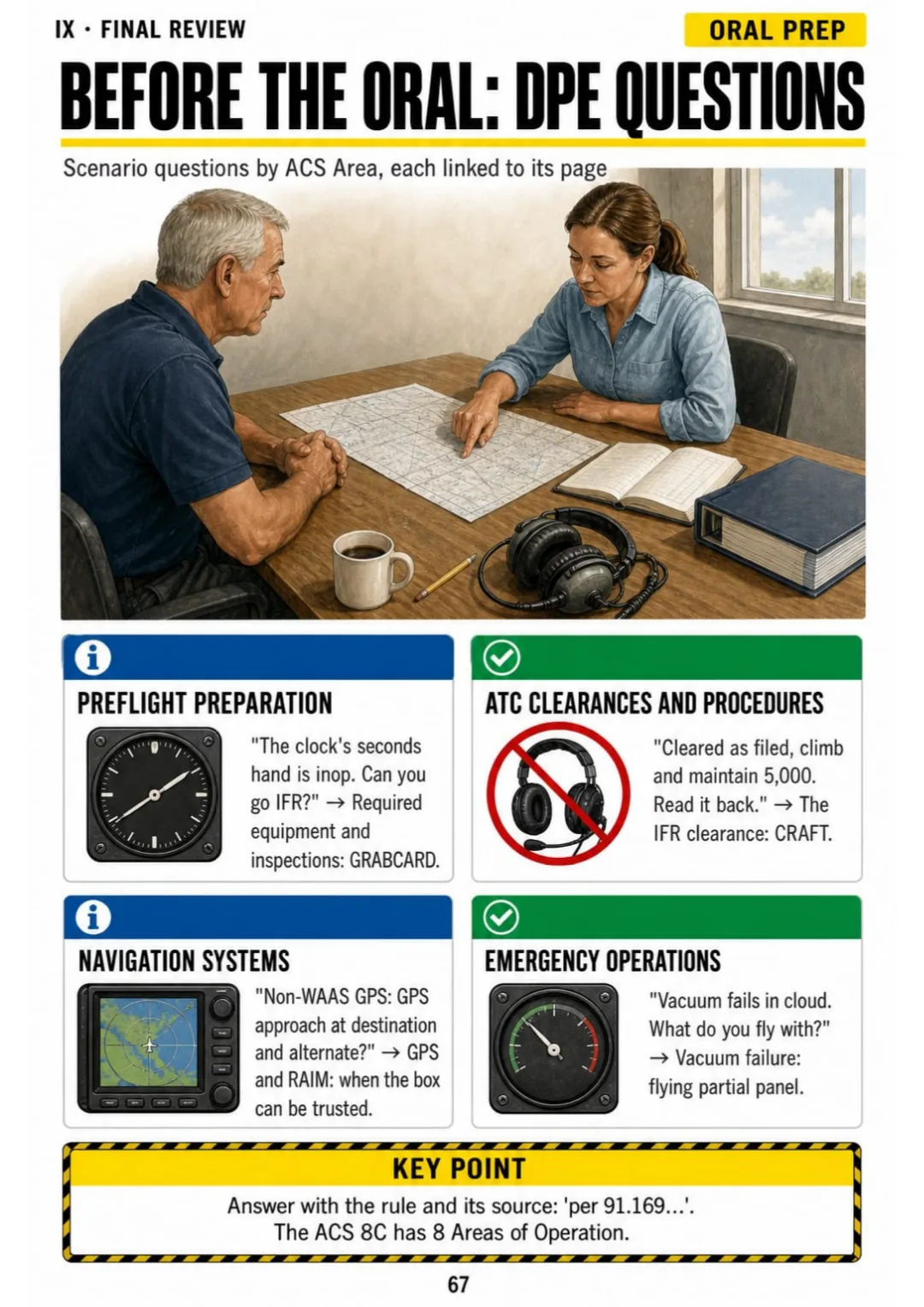
Every page has one big drawing and a box with the numbers, rules and steps you need to know:


Swipe to see more →
These are real pages from the book. The table of contents is the full one: 9 parts and 64 topics.
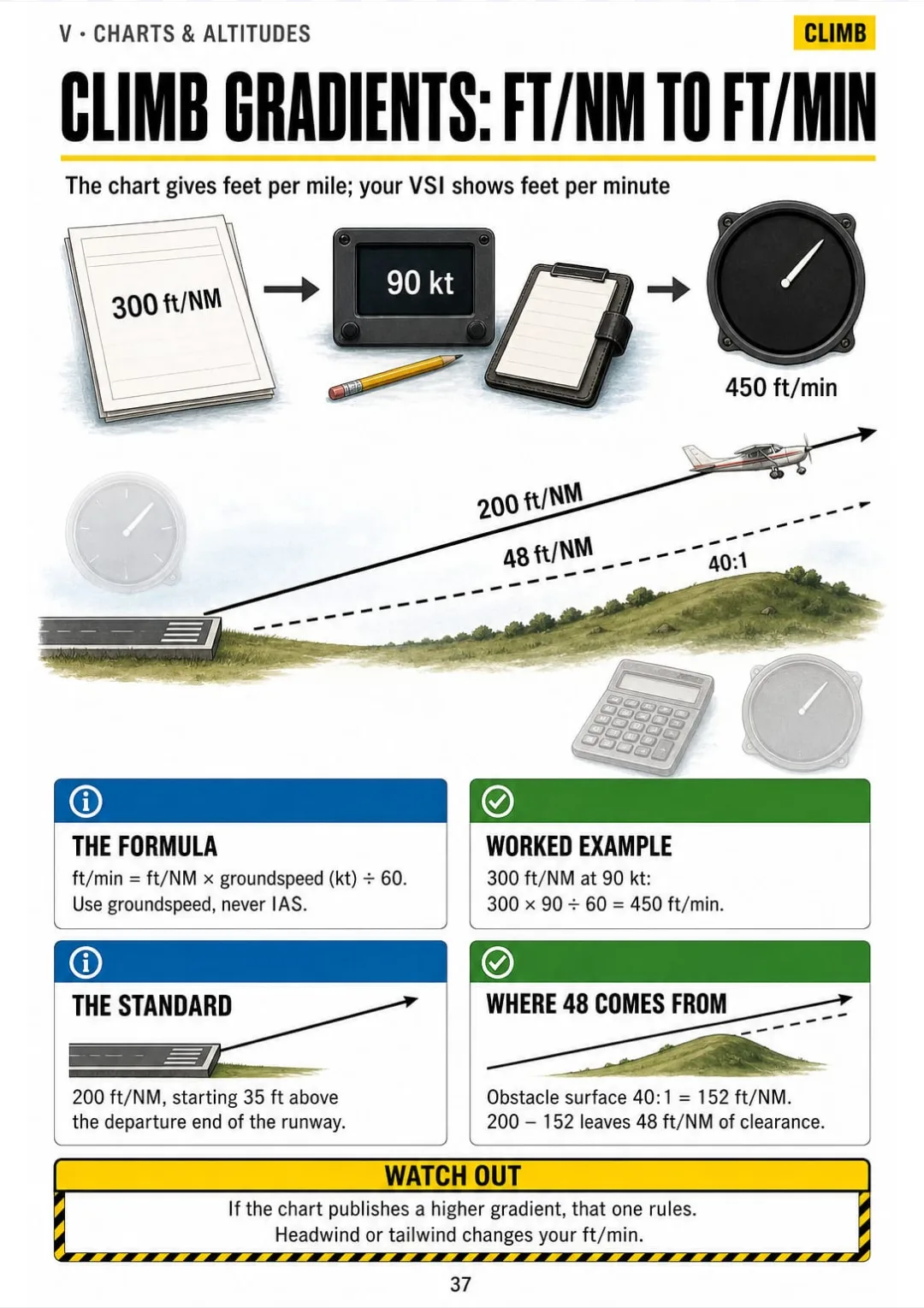
You're briefing a departure on the ground. The procedure calls for 300 feet per nautical mile, your groundspeed will be 90 knots, and the question is simple: can this airplane make that climb?
The handbook covers it in two dense paragraphs and a conversion table at the back of the terminal procedures. You read it, you nod, and an hour later you can't rebuild the math in your head.

In the book, climb gradients are one page: the climb drawn as a ramp, feet per NM on one side, feet per minute on the other, and one formula in a box. Gradient × groundspeed ÷ 60: 300 at 90 knots is 450 ft/min.
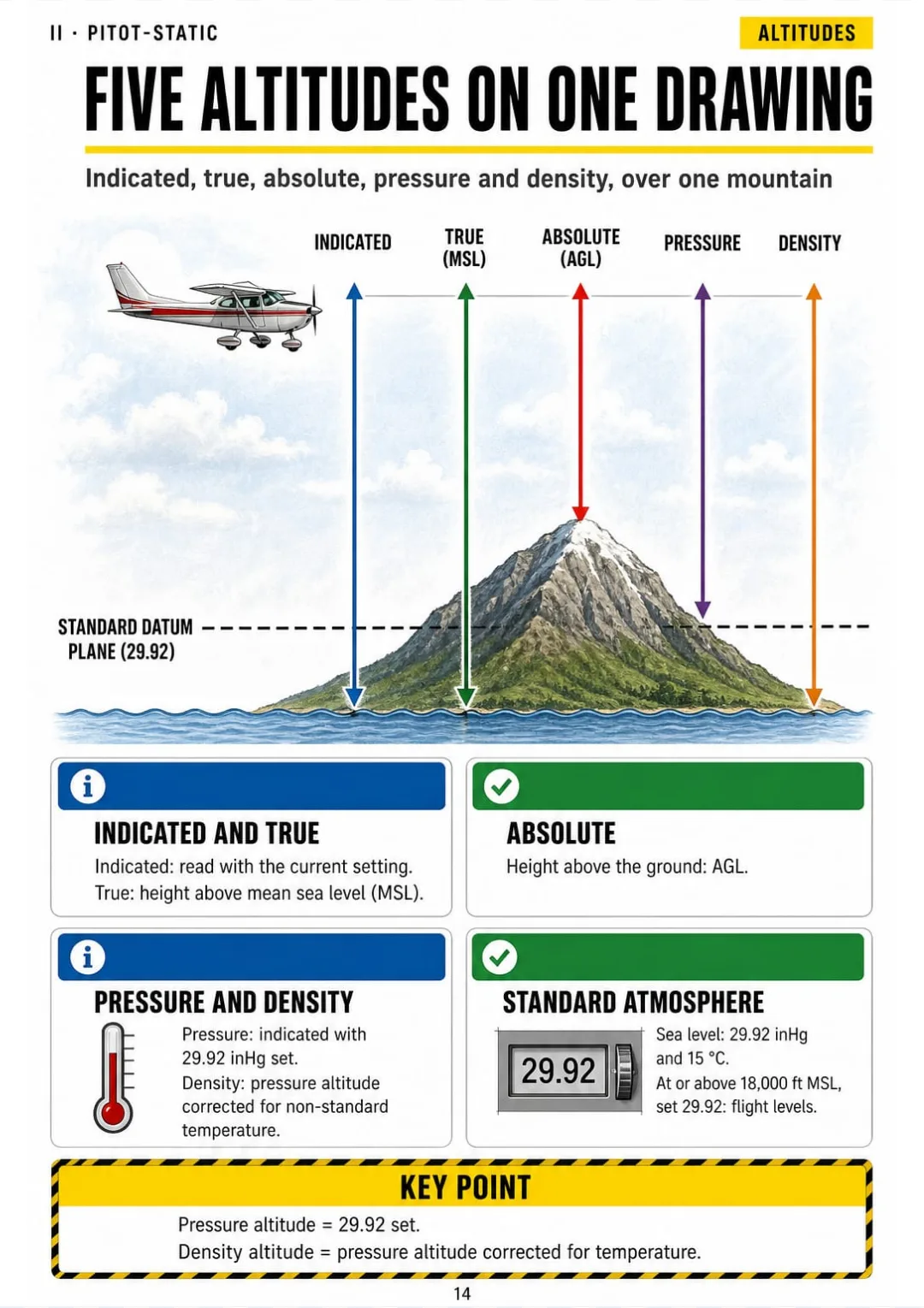
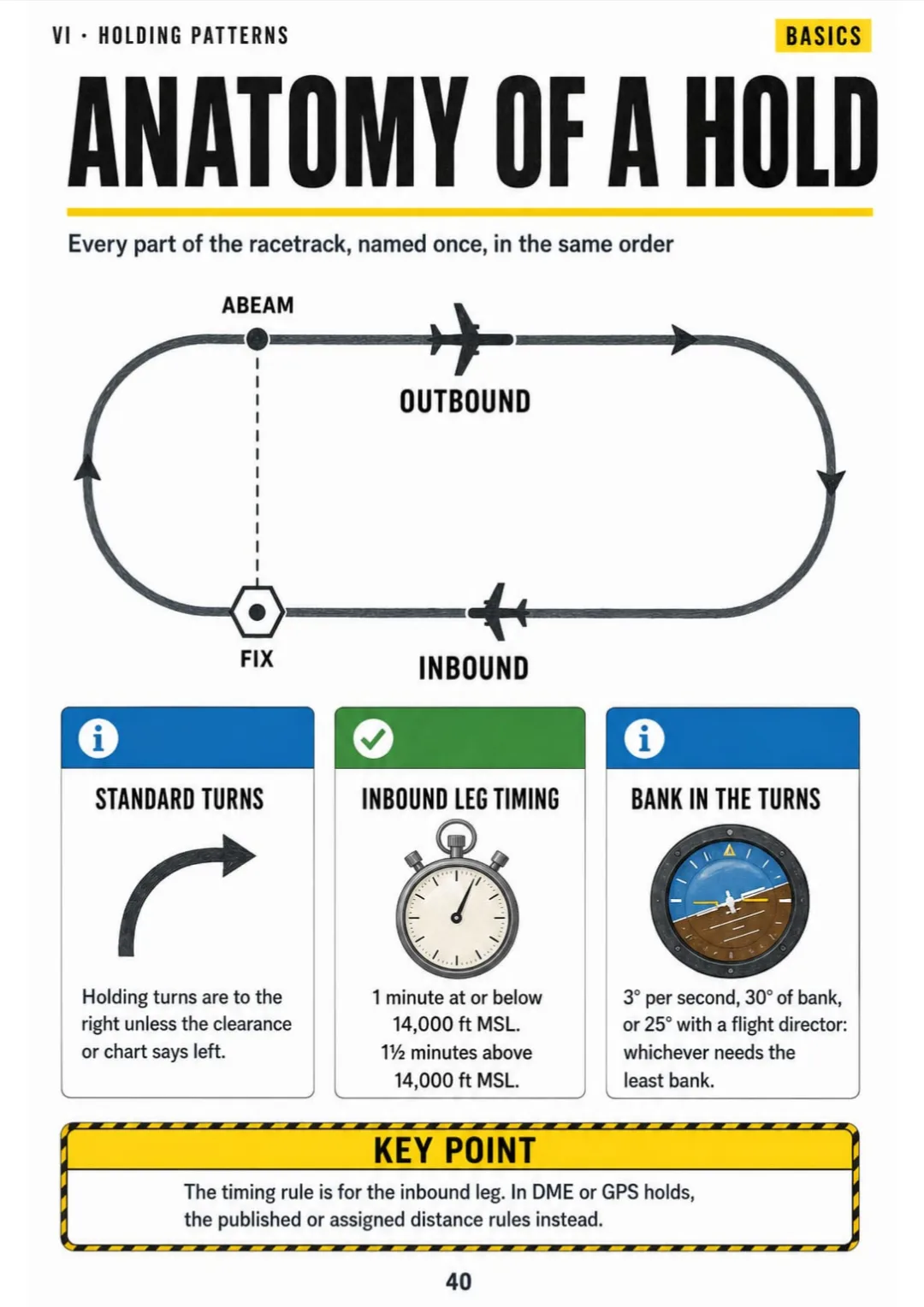
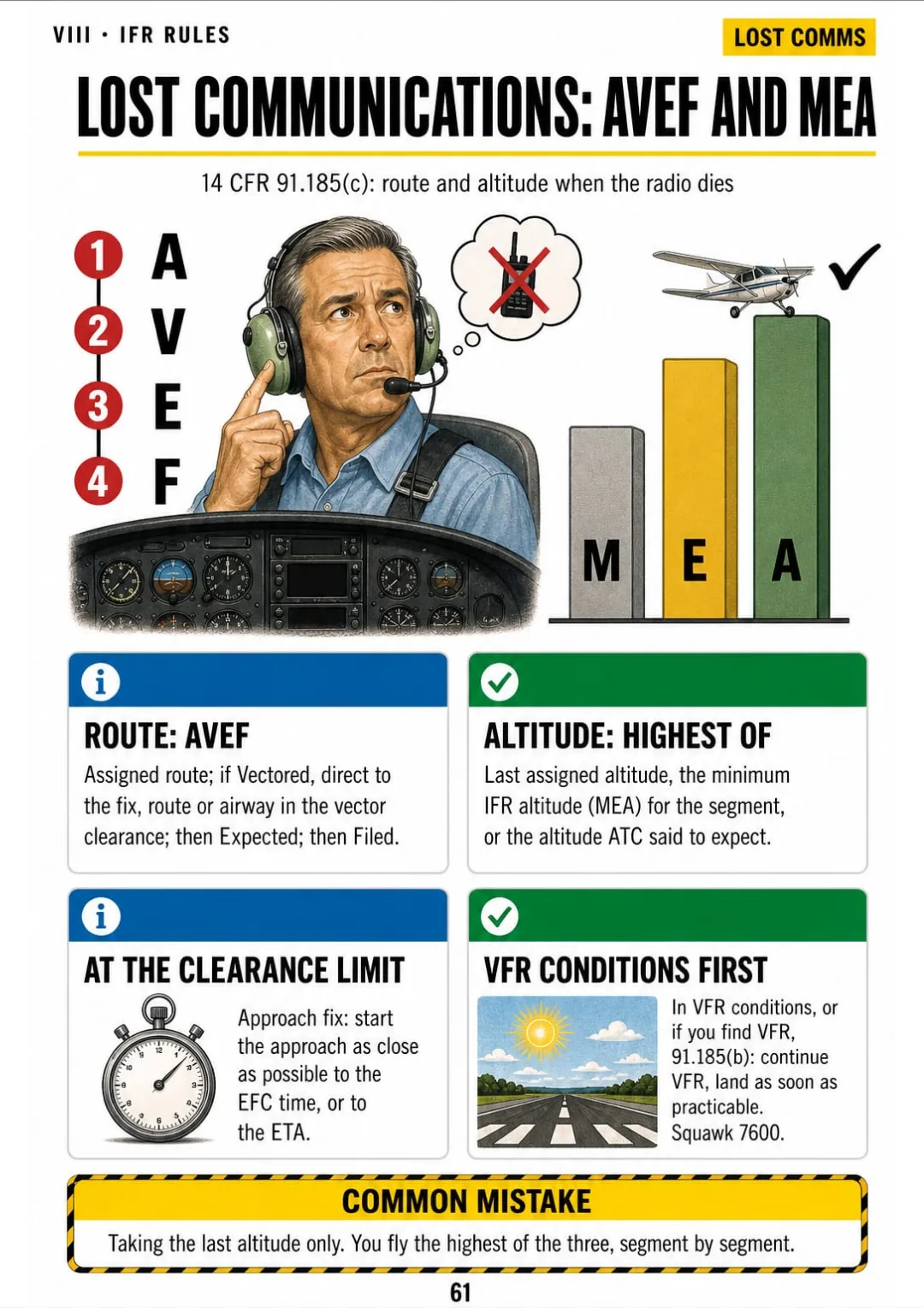
The rest works the same way: hold entries with the 70° line, the five altitudes, the ILS localizer and glide slope, lost comm under 91.185, the 1-2-3 rule. Each one has its own page.
Next time you look at a departure, you work out the number yourself, in the same order, without opening the handbook again.

The rating at a glance, the pitot-static panel, gyros and scan, navigation systems, charts and departures, holding patterns, approaches, IFR rules and weather, and a final review: 68 pages, all illustrated
Think of it this way:
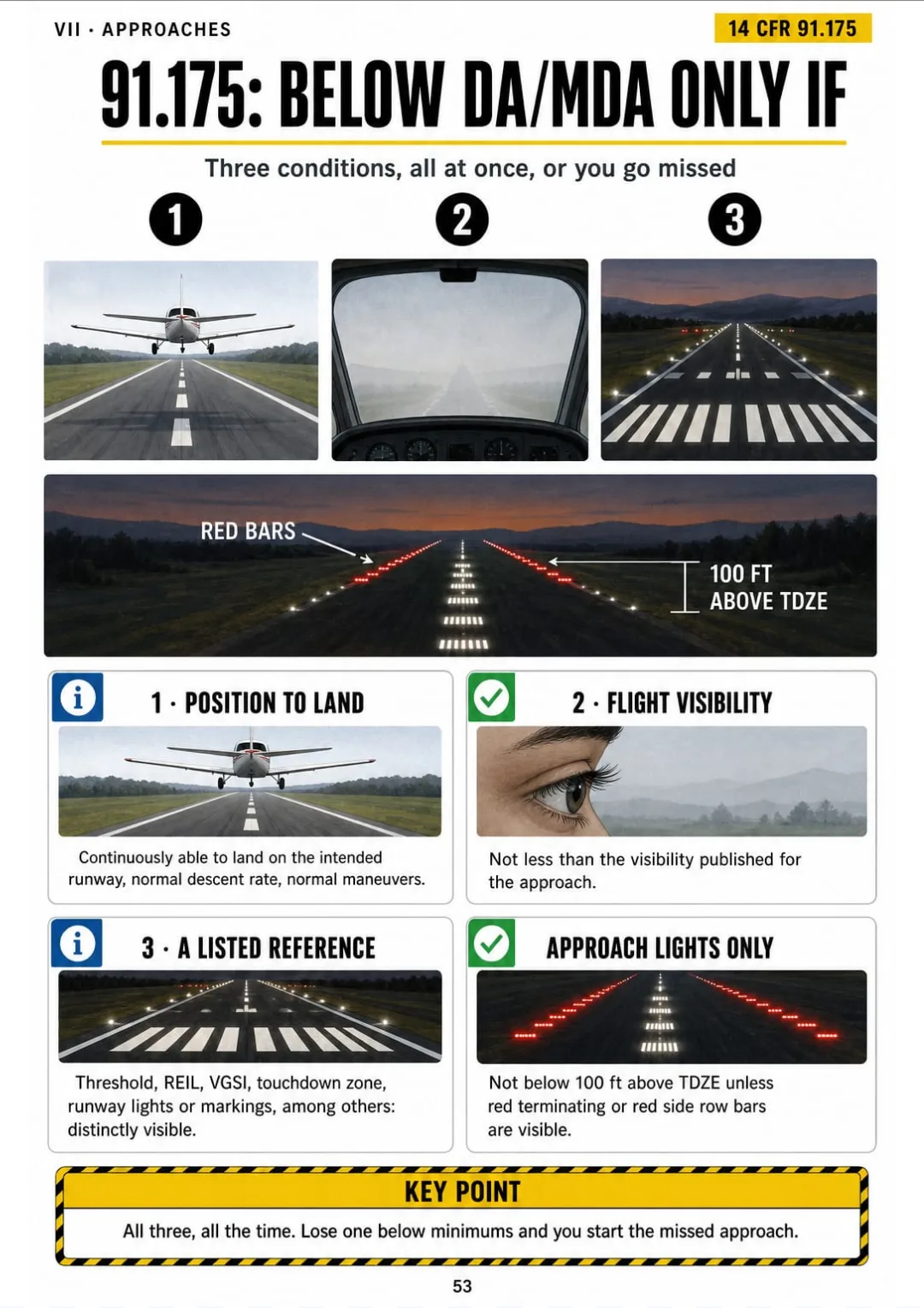
You're on a practice approach and your CFII asks: "You're at MDA. What do you need to keep descending?" You need the answer now, not after a page of text.
In the book, you open the 91.175 page and see it drawn: the airplane in position to land, the flight visibility, and one required visual reference, three boxes in a row.

Same with hold entries, the pitot-static failures, the ILS, lost comm and alternate minimums: each one on its own page.
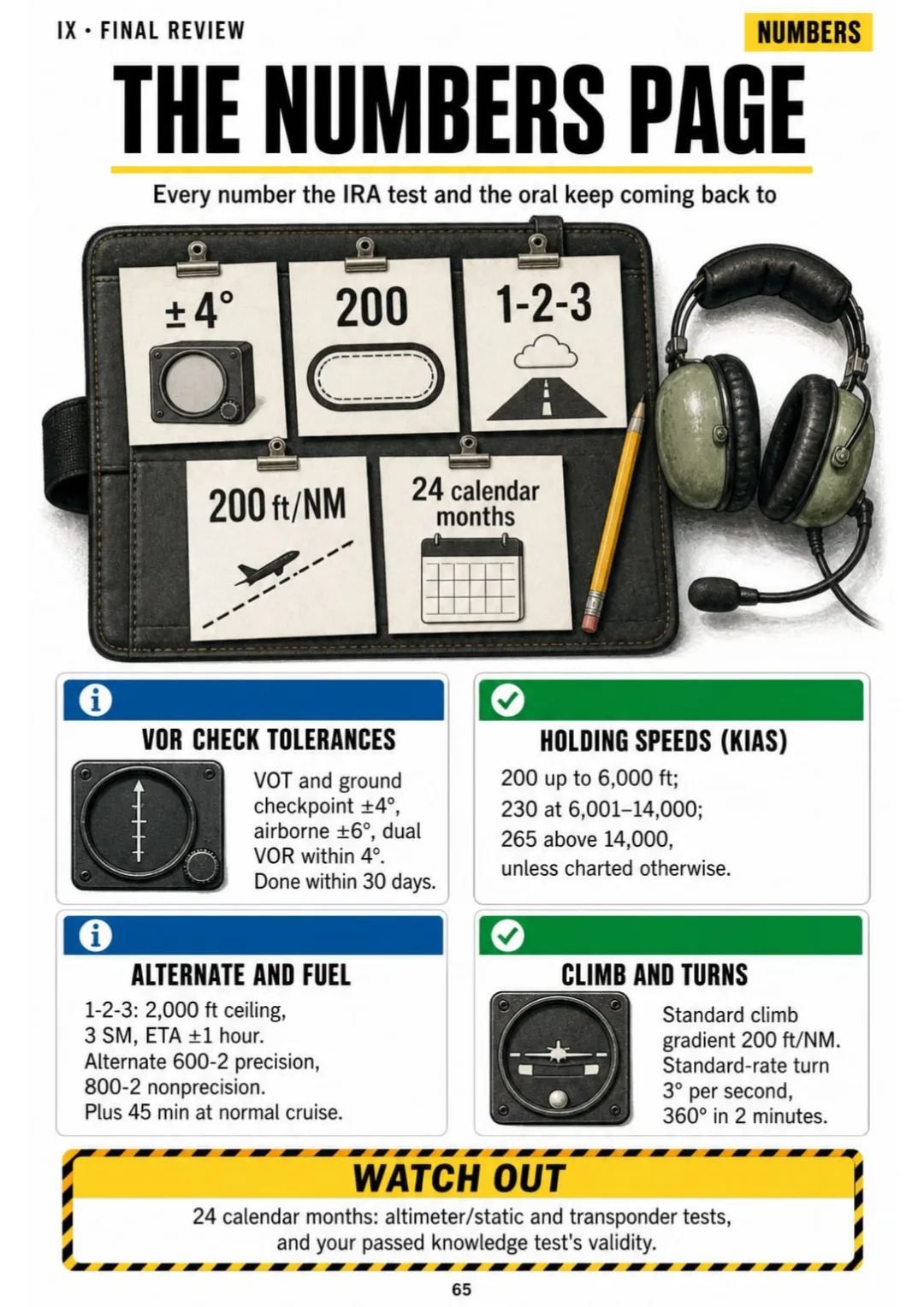
Instrument Rating Illustrated is 9 parts and 68 illustrated pages, one topic each, ending with a final review: the failure chart, the numbers page and the questions a DPE can ask.
What you see drawn, you don't have to memorize.
Know exactly what's ahead: what the IRA knowledge test covers, what 61.65 asks you to log, the ACS map and how every page is laid out.
The pitot-static system, blocked pitot and static port, the alternate source, the altimeter, the five altitudes, airspeeds and the VSI.
Attitude and heading indicators, the turn coordinator, compass errors, vacuum failure and partial panel, the scan and spatial disorientation.
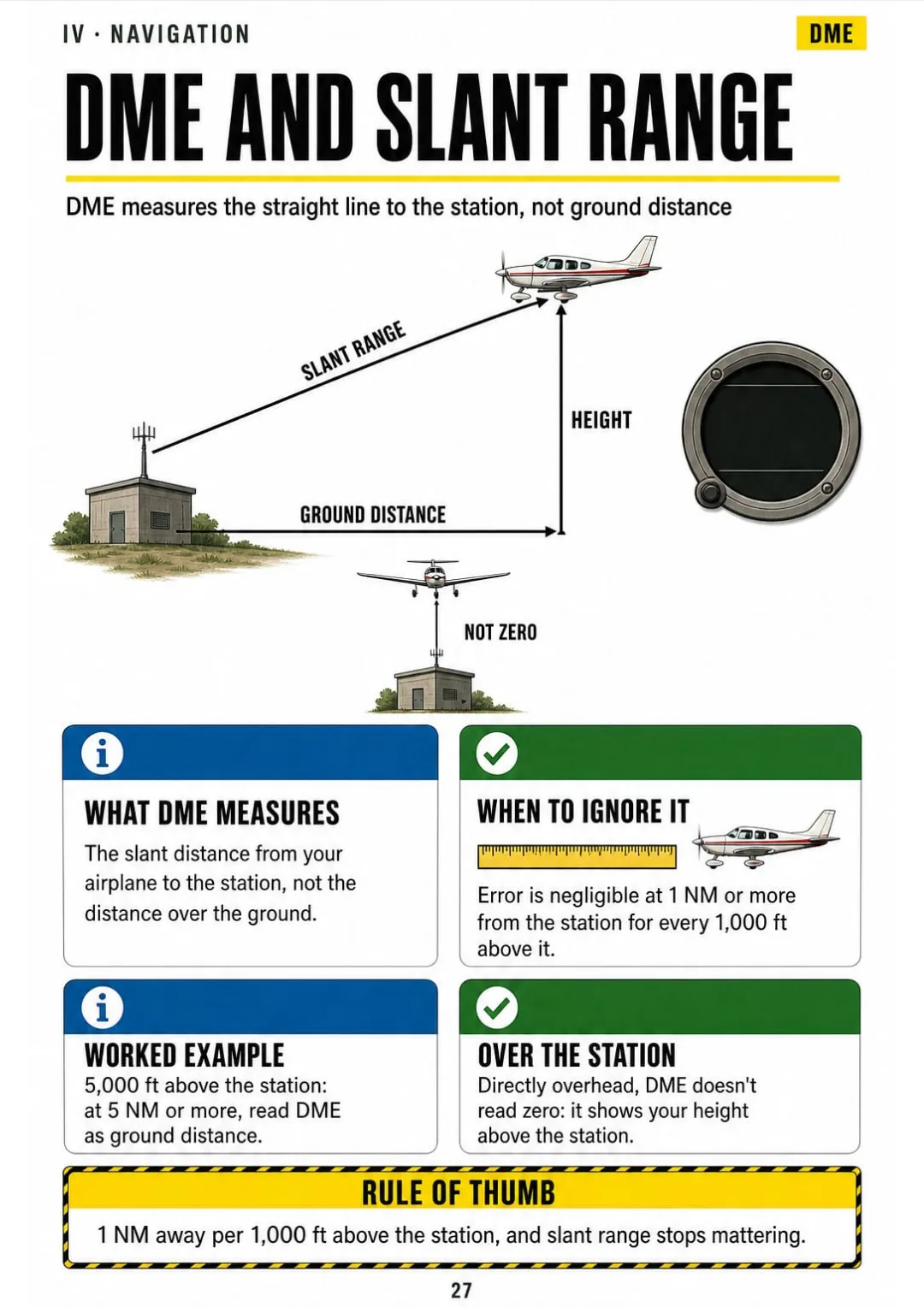
VOR and the CDI, VOR checks, DME, NDB and ADF, the ILS, GPS and RAIM, CDI scaling and course intercepts.
The en route low chart, minimum altitudes, IFR cruising altitudes, ODPs and SIDs, climb gradients, STARs and airspace.
Copy a holding clearance and fly the right entry without sketching: anatomy of a hold, clearances, entries in 3 steps, speeds and timing, wind correction, DME and GPS holds.
The approach chart in one order, the briefing strip, categories and minimums, DA vs. MDA, procedure turns, RNAV, descent rates, 91.175 and the missed approach.
CRAFT clearances, the 1-2-3 rule, alternate minimums, IFR fuel, currency and the IPC, required equipment, lost comm, ATC reports and IFR weather.
The pitot-static failure chart, the numbers page, common mix-ups, questions a DPE can ask and a pre-IFR flight checklist.
At the end of the book: A final review with the pitot-static failure chart, the numbers page, common mix-ups and a pre-IFR checklist.
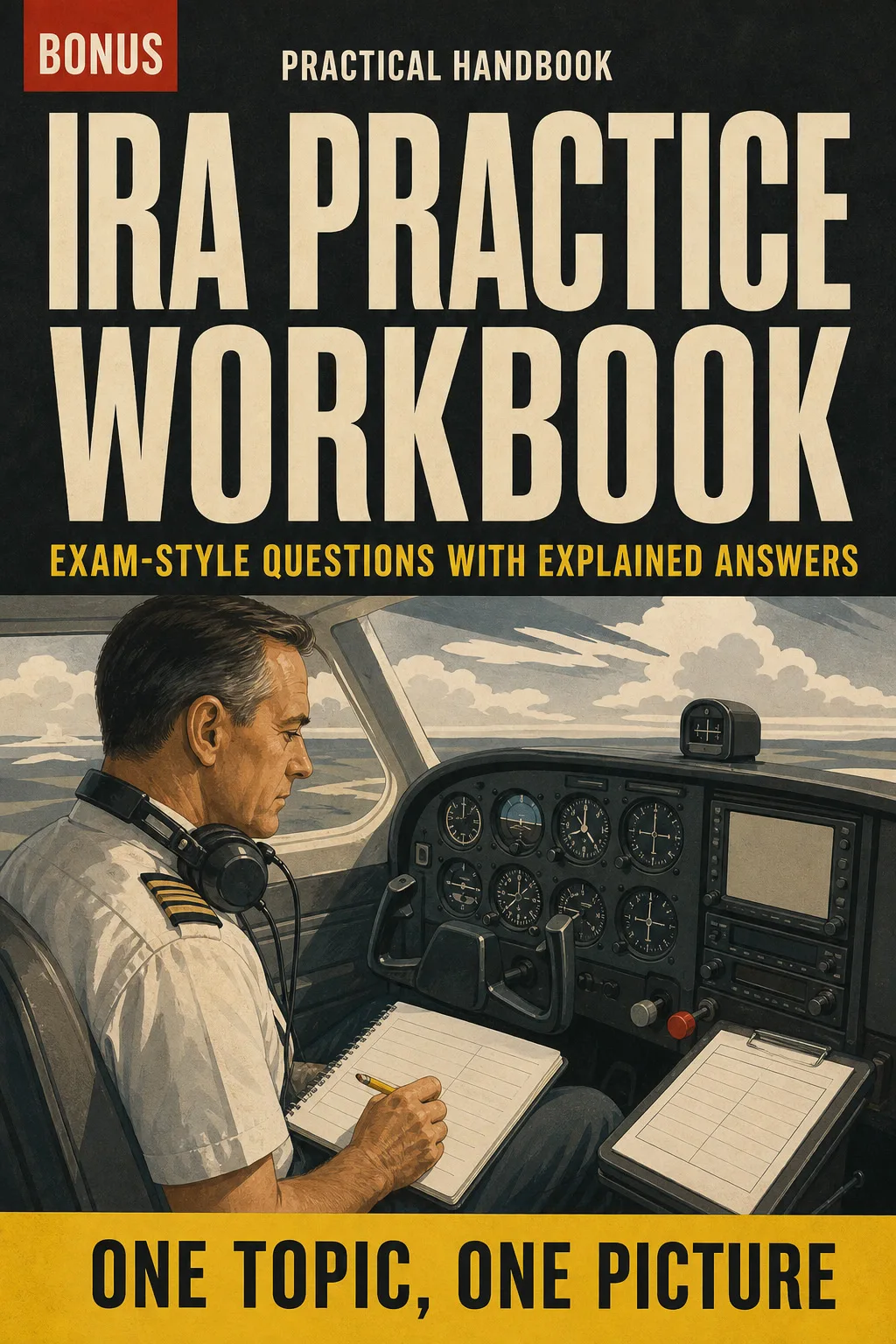
Test yourself in the knowledge test format and see, for every answer, which page of the book explains why.

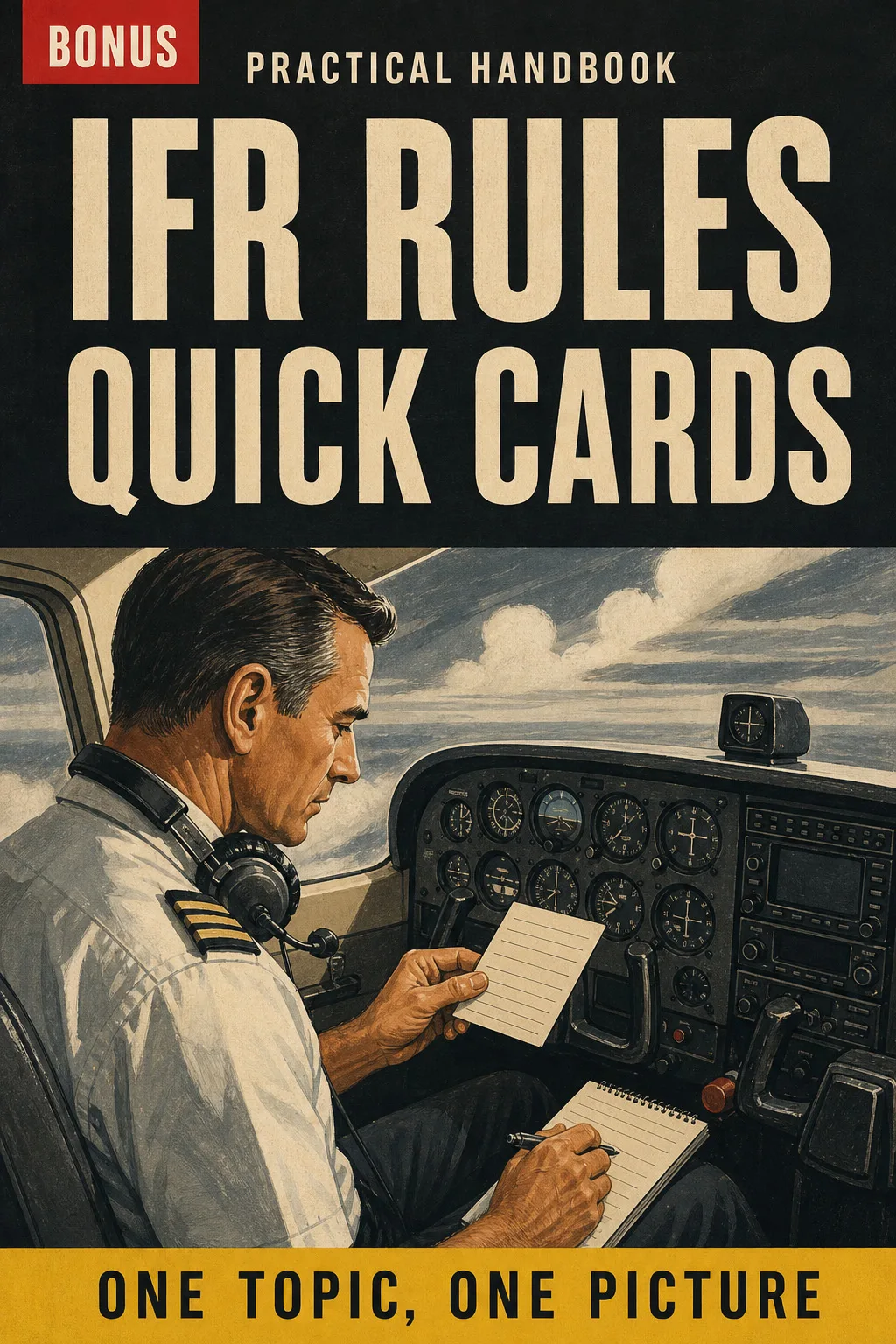
Currency, alternate minimums, the 1-2-3 rule, IFR fuel and required equipment on printable cards you can review in a few minutes before a lesson.
📄 This is a digital PDF book sent to your email: nothing is printed or shipped.
PDF by email: We email you Instrument Rating Illustrated as a PDF, together with the two free books. It's a single payment: no installments, no extra charges.
Between lessons, you review the page for what you flew that day: the hold, the approach, partial panel. Same order every time, so it sticks.
The numbers page puts alternates, fuel and currency in one place, and the practice workbook points every answer back to the page that explains it.
Before your IPC or your first approach in months, go back through the approach chart order, lost comm and 6 in 6, one page at a time.
📄 This is a digital PDF book sent to your email: nothing is printed or shipped.
Try Instrument Rating Illustrated for 30 days, bonus books included.
We refund everything if the file won't open, if the book isn't what you see here, if you were charged twice or if the email doesn't arrive. Just email us.
You pay once. No subscriptions.
Yes. It's written for private pilots working toward the rating and for instrument-rated pilots getting current again. It starts from the panel you already know and builds up to approaches and IFR rules.
From the FAA Instrument Flying Handbook (FAA-H-8083-15B), the Instrument Procedures Handbook (FAA-H-8083-16B), the AIM, 14 CFR Parts 61 and 91 and the Instrument Rating – Airplane ACS (FAA-S-ACS-8C), checked against those current editions. Always confirm against the latest FAA publications before you fly.
No. It's an independent illustrated study book built on the official FAA sources. It isn't published or endorsed by the FAA, and it doesn't include a certificate or the knowledge test endorsement: that comes from your CFII or an authorized ground school.
No. It's a study companion. Your question app tells you which answer is right; this book shows you why, one drawing per topic, so you can rebuild it in the airplane or on the oral. Your training, your CFII, the AIM and the current charts and publications always come first.
No. They're written for this book in the knowledge test format, and each answer points to the page that explains it.
The book and the 2 free books arrive as PDFs by email, at the address you enter at checkout.
No. It's a one-time payment, with no subscription.
Yes. It's a PDF you can print at home or at a print shop, or keep on your tablet. The drawn charts are illustrative and not for navigation.
You have 30 days. We refund everything if the file won't open, if the book isn't what you see on this page, if you were charged twice or if the email doesn't arrive: just email us.
No more rereading the handbook with nothing sticking.
Hold entries: you see them drawn, and that's it.
You walk into the knowledge test knowing where everything is.
Drawings make studying faster.
The book is right below.
One-time payment: US$ 27 · Guarantee: 30 days · PDF by email
YES, I WANT INSTRUMENT RATING ILLUSTRATED FOR US$ 27📄 This is a digital PDF book sent to your email: nothing is printed or shipped.